Politecnico di Milano,
Italy
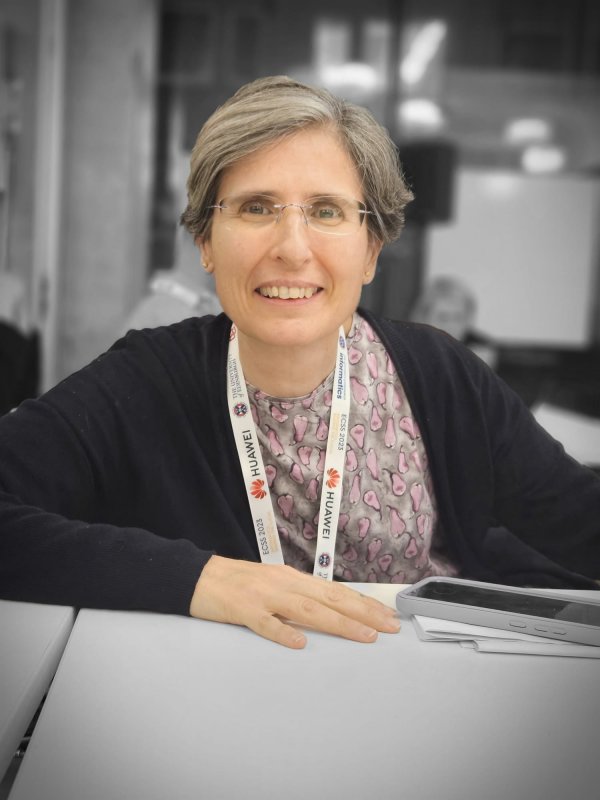
Elisabetta Di Nitto is Professor of software engineering at Politecnico di Milano. Her current research interests focus on quantum software design and development, software architectures and infrastructures for data intensive applications, cloud computing, process support systems, service-centric applications, dynamic software architectures, and self-adaptive systems. She has published and presented papers in the most important international journals and conferences in the software engineering area and is regularly serving in the program committee of A* conferences such as ICSE and ASE. She has been a member of the editorial board of the IEEE Trans. on Software Engineering, ACM Trans. on Software Engineering and Methodology, the SOCA journal, the Journal of Software: Evolution and Process and PeerJ Computer Science. In the last two years she has been program co-chair of the IEEE Quantum Software Conference (QSW), 2025 and 2026 editions. She has been also program co-chair of the 25th Conference on Automated Software Engineering (ASE 2010), and of SEAMS 2020, ACSOS 2022, and CASCON 2016, as well as general chair of ESEC/FSE 2015 and ICAC 2018. She has been PI for 10+ projects funded by the EU or the Italian Ministry of Research and has been coordinator of the MODAClouds FP7 IP project and Scientific Director/Technical Coordinator of the projects SeCSE (IP FP6), DICE (H2020), and SODALITE (H2020).
Quantum annealing is a quantum-based computation paradigm suited to address some classes of optimization problems that are hard on classical computers.Such approach is being used in multiple application domains ranging from aerospace to chemics, edge computing and software testing. Programming a quantum annealing solution means formulating an optimization problem in specific formats, i.e., QUBO or Ising. Such formulations are then embedded into a quantum annealer hardware that is run to find low energy configurations corresponding to candidate solutions to the given problem. In this lecture I’ll introduce the main concepts behind quantum annealing, including the practical limitations of current hardware. I’ll present examples of cases from different application domains we have addressed with quantum annealing. Moreover, I’ll show that this approach is not always able to bring a competitive advantage compared to classical approaches and I’ll try to identify the main characteristics a quantum annealing-friendly problem should have.
